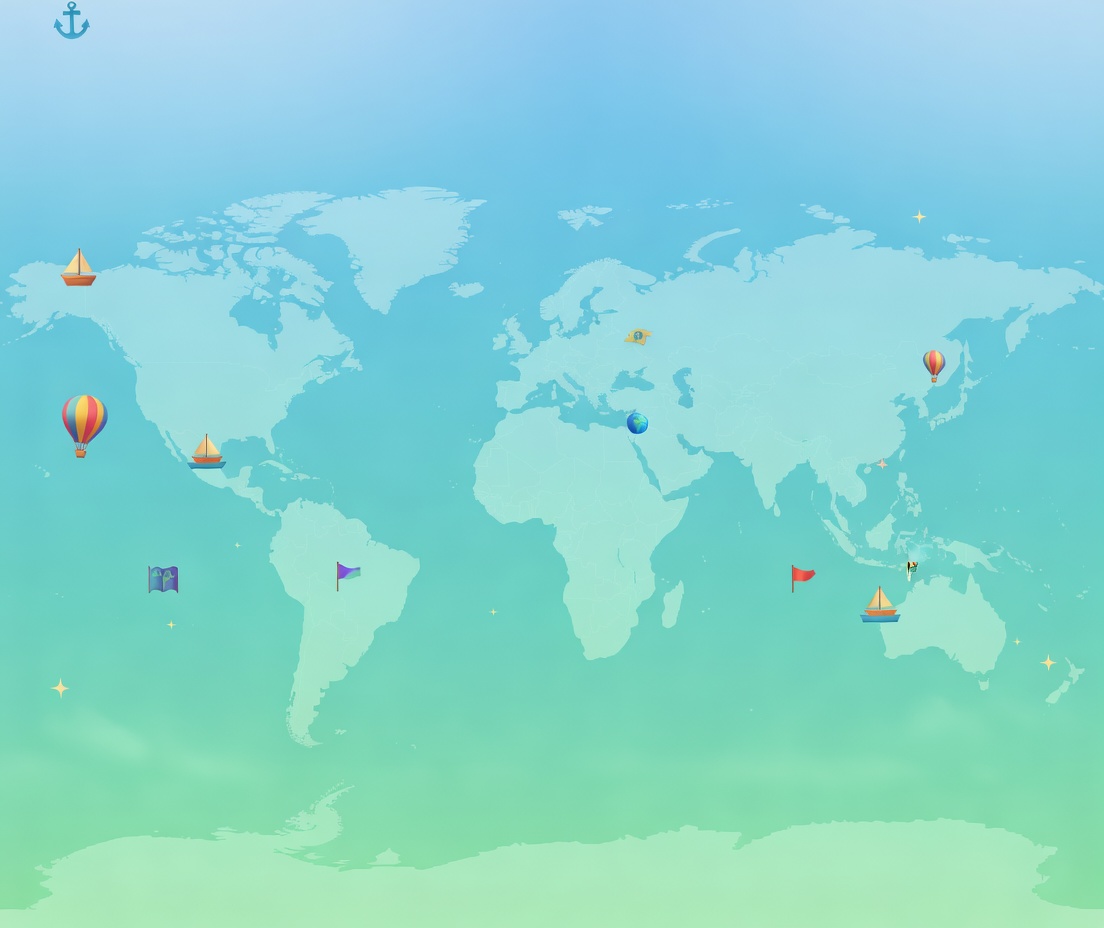
Our planet is home to roughly 195 countries, seven continents, five oceans, eight billion people and somewhere around eight million species of plants and animals. From the frozen interior of Antarctica to the dense rainforests of the Congo, from the highest peak of Everest to the deepest trench of the Pacific, the Earth is endlessly varied — and that variety is exactly what makes world geography so much fun to learn.
How geographers divide the world
There are a few different ways adults split up the world. The most common is by continent — Africa, Antarctica, Asia, Australia/Oceania, Europe, North America and South America — though some textbooks merge North and South America into a single 'Americas'. The world is also divided by the equator into the Northern and Southern Hemispheres, and by the prime meridian into the Eastern and Western Hemispheres. Climates run in broad bands from the icy polar regions through cool temperate zones to hot tropical regions near the equator. Once children grasp these big patterns, individual countries start to fit together like a jigsaw rather than feeling like a giant random list to memorise.
Oceans, mountains and rivers — the big features to know
Five oceans cover almost three-quarters of the planet's surface: the Pacific, Atlantic, Indian, Southern (around Antarctica) and Arctic. The Pacific alone is bigger than every continent put together. The world's longest river is debated — the Nile and the Amazon are very close — and its tallest mountain is Mount Everest, on the border of Nepal and China, at 8,849 metres. The deepest place is the Mariana Trench in the Pacific, almost 11 kilometres below sea level. Knowing a handful of these 'biggest, longest, highest' facts gives children landmarks they can hang the rest of their geography knowledge on.
Why world geography matters today
More than ever, the news, weather, sport, food and even the toys in the shops are global. A child who can confidently locate Ukraine, Taiwan, Brazil or Ethiopia on a map understands the world's headlines instead of being baffled by them. They also start asking better questions — Why are wildfires so common in Australia? Why do so many bananas come from Ecuador? Why is the Amazon so important to the climate? Geography is the gateway subject for almost every other adult topic that matters.
How to use this page
Below you'll find every world game and content area on the site. We recommend starting with the Country Facts to build a base of recognition, then moving onto the interactive World Map to see where everything is, and finally testing yourself with the quizzes. Aim for three stars on each one — and once you've done that, the Speed Challenges will keep you busy for a while.