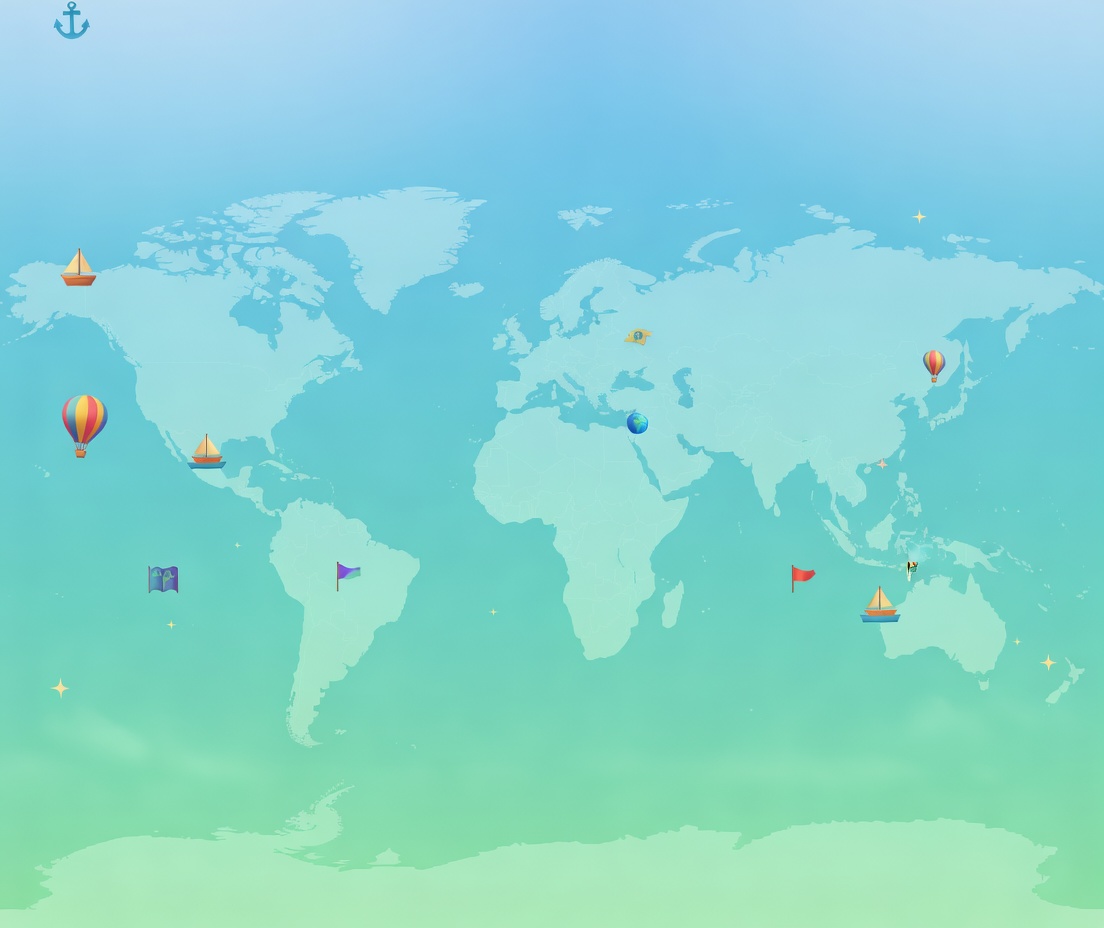
The Seven Continents Explained
⏱ 7 min read
Look at a globe and you will see big patches of land floating in a sea of blue. Those big patches are called continents. A continent is a very large area of land that is mostly surrounded by water. People who study geography have agreed on seven of them: Africa, Antarctica, Asia, Australia (also called Oceania), Europe, North America and South America. Together they hold every country, every mountain, every river, and almost every animal you can think of. Let's take a tour and meet each one.
What makes something a continent?
A continent is not just any big island. To count as a continent, a piece of land needs to be enormous, sit on its own slab of the Earth's crust (called a tectonic plate), and have its own mix of plants, animals and cultures. That is why Greenland, even though it is huge, is an island and not a continent: it sits on the same plate as North America.
Different countries actually teach slightly different numbers of continents. In some places children learn about six continents (joining Europe and Asia into 'Eurasia'), and in others they learn about five (joining the Americas together). The most common version taught around the world today is seven, and that is the one we will use.
Asia — the giant
Asia is the biggest and most crowded continent. About 4.7 billion people live there, which is more than half of everyone on Earth. It is home to the tallest mountain (Mount Everest), one of the longest rivers (the Yangtze) and the deepest lake (Lake Baikal in Russia).
Asia stretches from the icy forests of Siberia in the north all the way down to the steamy jungles of Indonesia near the equator. It includes 49 countries and dozens of languages, foods and traditions.
Africa — the cradle of life
Africa is the second-largest continent and the warmest of them all. The Sahara Desert in the north is bigger than the entire United States. The Nile, which many people call the longest river in the world, flows north through Africa for over 6,650 kilometres before it reaches the Mediterranean Sea.
Africa is famous for its wildlife: elephants, lions, giraffes, zebras and gorillas all live there in the wild. Scientists believe the very first humans appeared in Africa millions of years ago.
North America — from icebergs to rainforests
North America stretches from the frozen islands of northern Canada all the way down through Mexico to the narrow countries of Central America. It contains 23 countries, including big ones like the United States and tiny island nations in the Caribbean.
It is the continent of the Grand Canyon, the Mississippi River, Niagara Falls and the giant redwood trees of California — some of the tallest living things on Earth.
South America — home of the Amazon
South America has just 12 countries but some of the most amazing nature on the planet. The Amazon rainforest covers a huge part of the continent and produces a big slice of the oxygen we breathe. The Andes mountains run all the way down its western coast — the longest mountain range in the world.
Look here for jaguars, sloths, anacondas, llamas, and the colourful birds called macaws.
Antarctica — the frozen one
Antarctica is the coldest, windiest and driest continent. There are no countries and no permanent residents — just scientists who visit research stations to study the ice and the wildlife. Almost the entire continent is covered in a sheet of ice nearly 2 kilometres thick.
Penguins, seals and whales live around its coast, but you will not find any polar bears here. Polar bears live at the other end of the world, in the Arctic.
Europe — small but mighty
Europe is the second-smallest continent but has more than 40 countries packed into it. Many famous historical events happened here, from the ancient Greek Olympics to the building of castles in the Middle Ages. You can hear hundreds of languages spoken across Europe.
Europe is connected to Asia by land. The two together are sometimes called Eurasia, but most schools teach them as separate continents.
Australia / Oceania — the island continent
Australia is the smallest continent. The wider region around it, called Oceania, includes thousands of Pacific islands like New Zealand, Fiji and Papua New Guinea. Because Australia broke away from the other continents a very long time ago, it has unique animals you cannot find anywhere else: kangaroos, koalas, platypuses and wombats.
The Great Barrier Reef, the largest coral reef in the world, lies just off the Australian coast.
How to remember all seven
A simple trick is to use the first letter of each continent to make a sentence. Try this one: 'Eat An Aspirin After A Nasty Sandwich' — Europe, Antarctica, Asia, Africa, Australia, North America, South America. Make up your own silly sentence to help you remember!
Continents are like giant puzzle pieces that make up our planet. Each one has its own story, its own animals, its own people, and its own incredible places to discover. Now that you know the seven, try finding them on a globe — and pick one to learn about more deeply next.